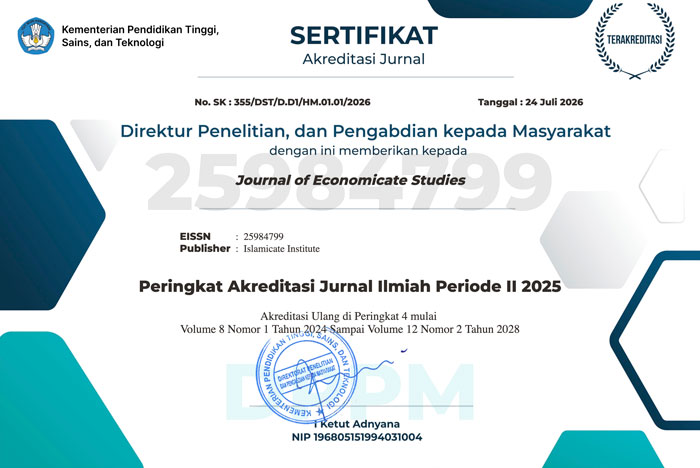
Beyond Economic Growth: Rethinking Religion as an Ethical Resource for Inclusive and Sustainable Development
DOI:
https://doi.org/10.32506/jsvjea28Keywords:
religious ethics, Islamic economic thought, inclusive development, distributive, justice, human flourishing, sustainable developmentAbstract
Modern economic development has expanded productive capacity and material prosperity, yet persistent inequality, social exclusion, and ecological degradation raise fundamental questions about the ethical purposes of economic progress. This article reexamines religion as a potential ethical resource for inclusive and sustainable development, with particular attention to contributions from Islamic economic thought. Employing a critical integrative literature review, it brings religious ethics into dialogue with institutional economics, the capability approach, and contemporary theories of distributive justice. The analysis focuses on how religious values may inform economic behavior, institutional accountability, social redistribution, and environmental responsibility. Islamic concepts such as ‘adl (justice), maṣlaḥah (public welfare), falāḥ (human flourishing), and amānah (responsibility) provide a complementary perspective for reconsidering development beyond economic growth. The article argues that the developmental relevance of religious ethics cannot be assumed from normative teachings alone but depends on their institutional interpretation, practical implementation, and compatibility with pluralistic public values. It proposes an integrative conceptual framework connecting ethical commitments, economic institutions, distributive justice, and ecological sustainability. This perspective contributes to ongoing debates on the moral dimensions of economic development without reducing economic analysis to religious prescriptions.
Downloads
References
Braun, V., & Clarke, V. (2006). Using thematic analysis in psychology. Qualitative Research in Psychology, 3(2), 77–101. https://doi.org/10.1191/1478088706qp063oa
Chapra, M. U. (1992). Islam and the economic challenge. The Islamic Foundation.
Chapra, M. U. (2000). The future of economics: An Islamic perspective. The Islamic Foundation.
Chapra, M. U. (2008). The Islamic vision of development in the light of the maqāṣid al-Sharī’ah. Islamic Research and Training Institute.
Dasgupta, P. (1993). An inquiry into well-being and destitution. Clarendon Press.
Dasgupta, P. (2021). The economics of biodiversity: The Dasgupta review. HM Treasury.
Durkheim, E. (1995). The elementary forms of religious life (K. E. Fields, Trans.). Free Press. (Original work published 1912)
El-Gamal, M. A. (2006). Islamic finance: Law, economics, and practice. Cambridge University Press.
Foltz, R. C., Denny, F. M., & Baharuddin, A. (Eds.). (2003). Islam and ecology: A bestowed trust. Harvard University Press.
Habermas, J. (2006). Religion in the public sphere. European Journal of Philosophy, 14(1), 1–25. https://doi.org/10.1111/j.1468-0378.2006.00241.x
Kahf (1999) zakat
Kuran, T. (2001). The provision of public goods under Islamic law: Origins, impact, and limitations of the waqf system. Law & Society Review, 35(4), 841–897. https://doi.org/10.2307/3185418
Kuran, T. (2004). Islam and Mammon: The economic predicaments of Islamism. Princeton University Press.
Milanovic, B. (2016). Global inequality: A new approach for the age of globalization. Harvard University Press.
North, D. C. (1990). Institutions, institutional change and economic performance. Cambridge University Press.
Nussbaum, M. C. (2011). Creating capabilities: The human development approach. Belknap Press of Harvard University Press.
Ostrom, E. (1990). Governing the commons: The evolution of institutions for collective action. Cambridge University Press.
Piketty, T. (2014). Capital in the twenty-first century (A. Goldhammer, Trans.). Belknap Press of Harvard University Press.
Polanyi, K. (2001). The great transformation: The political and economic origins of our time. Beacon Press. (Original work published 1944)
Putnam, R. D. (1993). Making democracy work: Civic traditions in modern Italy. Princeton University Press.
Rawls, J. (1999). A theory of justice (Rev. ed.). Belknap Press of Harvard University Press. (Original work published 1971)
Raworth, K. (2017). Doughnut economics: Seven ways to think like a 21st-century economist. Chelsea Green Publishing.
Scott, J. C. (1976). The moral economy of the peasant: Rebellion and subsistence in Southeast Asia. Yale University Press.
Sen, A. (1987). On ethics and economics. Basil Blackwell.
Sen, A. (1999). Development as freedom. Alfred A. Knopf.
Sen, A. (2009). The idea of justice. Belknap Press of Harvard University Press.
Smith, A. (2002). The theory of moral sentiments (K. Haakonssen, Ed.). Cambridge University Press. (Original work published 1759)
Snyder, H. (2019). Literature review as a research methodology: An overview and guidelines. Journal of Business Research, 104, 333–339. https://doi.org/10.1016/j.jbusres.2019.07.039
Stiglitz, J. E., Sen, A., & Fitoussi, J.-P. (2009). Report by the Commission on the Measurement of Economic Performance and Social Progress. Commission on the Measurement of Economic Performance and Social Progress.
Thompson, E. P. (1971). The moral economy of the English crowd in the eighteenth century. Past & Present, 50(1), 76–136. https://doi.org/10.1093/past/50.1.76
Torraco, R. J. (2005). Writing integrative literature reviews: Guidelines and examples. Human Resource Development Review, 4(3), 356–367. https://doi.org/10.1177/1534484305278283
Weber, M. (2002). The Protestant ethic and the spirit of capitalism (P. Baehr & G. C. Wells, Trans.). Penguin Books. (Original work published 1905)
World Bank. (2017). World development report 2017: Governance and the law. https://doi.org/10.1596/978-1-4648-0950-7
Downloads
Published
Issue
Section
License
Copyright (c) 2026 Sholihuddin

This work is licensed under a Creative Commons Attribution-NonCommercial-ShareAlike 4.0 International License.