Effect of Work Environment and Work Motivation on Employee Performance in Faculty of Forestry University North Sumatra
DOI:
https://doi.org/10.32506/joes.v3i2.637Keywords:
Work Environment, Work Motivation, PerformanceAbstract
Research with the title "The Effect of Work Environment and Work Motivation on Employee Performance at the Faculty of Forestry, University of North Sumatra" This study aims to explain the effect of working environment variables and work motivation simultaneously and partially on employee performance at the Faculty of Forestry, University of North Sumatra. The research method used is a quantitative model, using a questionnaire as a means of collecting data which is distributed to 45 employees at the Faculty of Forestry, University of North Sumatra. Analysis of the data in this study using multiple linear regression analysis assisted by a computer program SPSS for Windows. The results showed that simultaneously the F test resulted in an Fcount of 1339.803 with a significant level of 0.00. Because Fcount 1339.803> Ftable 3.22 and the significant probability is much smaller than 0.05, namely 0.00 <0.05, the regression model can be said that the work environment and work motivation simultaneously have a positive and significant effect on employee performance. . The results showed that partially the work environment tcount 1.259 <ttable 1.681 with a significant 0.215> 0.05, meaning that partially work environment variables did not have a positive and significant effect on employee performance. The results showed that work motivation tcount 13.831> ttable 1.681 with a significant 0.000 <0.050, meaning that partially the work motivation variable has a positive and significant effect on employee performance. Based on the amount of the adjusted R square of 0.984, this means that 98.4% of the variation in work performance can be explained by the independent variable of work discipline and work environment while the rest (100% - 97.2% = 1.6%) can be explained by independent variables. others who were not included in this study such as the variables of work stress, work discipline and others.
Downloads
References
Anoraga. (2014). Psikologi Kerja. Rineka Cipta.
Arikunto, S. (2005). Prosedur Penelitian Suatu Pendekatan Praktek. PT Rineka Cipta.
Arikunto, S. (2006). Metode Penelitian Kualitatif. Bumi Aksara.
Donnelly, Gibson, & Ivancevich. (1996). Manajemen (Z. Ichyaudin, Penerj.; Edisi Sembilan Jilid 1). Erlangga.
Edison, Anwar, & Komariah. (2016). Manajemen Sumber Daya Manusi. Alfabeta.
Hasibuan. (2012). Manajemen Sumber Daya Manusia. PT. Bumi Aksara.
Kasmir. (2018). Manajemen Sumber Daya Manusia (Teori dan Praktik). PT Raja Grafindo Persada.
Mangkunegara, A. P. (2013). Manajemen Sumber Daya Manusia Perusahaan. Remaja Rosda Karya.
Robbins, S. P., & Judge, T. A. (2013). Organizational Behavior. Pearson Education.
Roziqin, M. Z. (2012). Kepuasan Kerja. Averoes Press.
Rusiadi, Subiantoro, Nur, & Muhammad. (2016). Metode Penelitian: Manajemen, Akuntansi dan Ekonomi Pembangunan. Konsep, Kasus dan Aplikasi SPSS, Eviews, Amos, Lisrel. USU Press.
Sahlan, A., & Teguh. (2012). Desain Pembelajaran Berbasis Pendidikan Karakter. Ar Ruzz Media.
Sarwoto. (2014). Dasar-Dasar Organisasi dan Manajemen. Ghalia Indonesia.
Sedarmayanti. (2011). Manajemen Sumber Daya Manusia, Reformasi Birokrasi Manajemen Pegawai Negeri Sipil. Rafika Aditama.
Sunyoto. (2015). Penelitian Sumber Daya Manusia. Buku Seru.
Sutrisno, E. (2016). Manajemen Sumber Daya Manusia. Kencana Prenada Media Grup.
Winardi. (2011). Kepemimpinan dalam Manajemen. PT Rineka Cipta.
Downloads
Published
Issue
Section
License
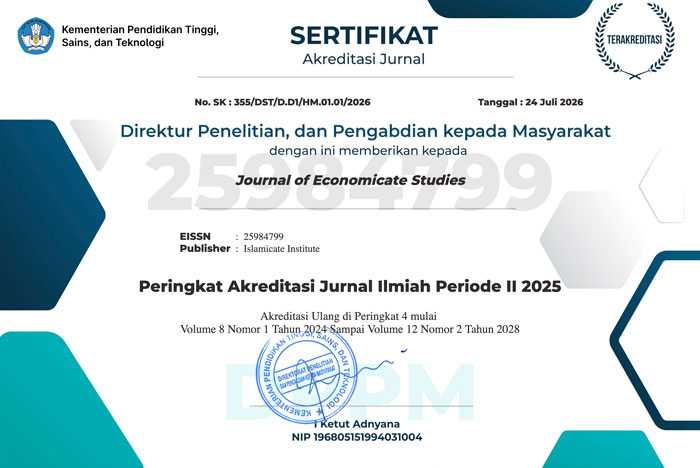
Copyright (c) 2021 Journal of Economicate Studies

This work is licensed under a Creative Commons Attribution-NonCommercial-ShareAlike 4.0 International License.